The Biology Layer Most Optimizers Miss
You track your sleep. You eat clean. You train consistently and supplement smart. So why does your energy, focus, and recovery still feel like they're running slightly below where they should be? The answer probably isn't in your routine. It may be in your cells.

You are not the person who skips the gym.
You're not the person who eats like garbage, stays up until 2am scrolling, and then wonders why they feel terrible. You've put in the work to understand what your body needs and you've built a life around giving it those things. The sleep schedule. The protein targets. The training program. The morning routine that most people would call extreme and you just call Tuesday.
By every external measure, you're doing it right.
And yet.
There's a ceiling you keep bumping into. Not a dramatic, obvious one — you're not falling apart. But a subtle, persistent one. The kind you can only detect because you know what your baseline used to feel like, and you know this isn't it.
Your output in the gym is marginally harder to generate than it was two or three years ago. Your recovery window has quietly stretched. You used to bounce back in a day; now it's two, sometimes three. Your focus during deep work sessions — the ones that used to feel effortless — now requires more management. More coffee, more noise-cancelling, more forcing. The drive that used to pull you toward your work now needs to be pushed. You're producing the same results, but it costs more to get there.

You've tried tightening everything up. Stricter sleep hygiene. Earlier caffeine cutoff. More precise nutrition timing. A new pre-workout. A different supplement stack. A better recovery protocol. These things help, at the margins. But the ceiling stays where it is.
Here's what none of those adjustments are addressing: the floor.
The Stack That Sits on Top of Nothing
Most optimization strategies — and there are good ones, built on solid research — are operating at the same level of the hierarchy. Diet, sleep, training, supplementation, stress management: these are all inputs that interact with your body's existing systems. They're important. They work.
But they all rest on a foundation that almost no one talks about, and that foundation is your cells' ability to produce energy in the first place.
Not the energy you feel from caffeine. Not the energy that comes from a good night's sleep. The upstream version. The one that determines how efficiently your mitochondria convert everything you consume — food, oxygen, all of it — into actual biological output.
If that layer is compromised, every optimization strategy you stack on top of it is working against a diminished foundation. Better sleep still runs through a less efficient cellular energy system. Pre-workout still hits mitochondria that are operating below capacity. Protein synthesis still requires cellular machinery that is running on a depleted substrate.
You can optimize everything above the foundation and still hit the same ceiling, because the ceiling is set at a level below where your inputs are touching.
This is the layer most optimizers miss. Not because they're not smart enough to find it — but because mainstream fitness and wellness culture almost never talks about it. The conversation stays at the level of macros, sleep cycles, VO2 max, HRV. These are real metrics. But they're downstream of something more fundamental.
That something is a molecule called NAD+.

The Molecule Your Optimization Stack Assumes Is There
NAD+ — nicotinamide adenine dinucleotide — is not a supplement trend. It's a coenzyme that exists in every single cell in your body, and it has been studied in biochemistry for over a century.
NAD+ is the critical carrier molecule that powers your mitochondria's electron transport chain — the process by which your cells convert food and oxygen into ATP, the biological currency of all energy. It also activates sirtuin enzymes — what researchers at Harvard and elsewhere have called the "longevity pathway" — responsible for DNA repair, metabolic regulation, and cellular stress response. Without sufficient NAD+, every downstream system operates below its designed capacity.
When you're in your 20s, NAD+ production is robust. Your cells make it efficiently, use it effectively, and replenish it without much difficulty. It's one of the reasons a 24-year-old can train hard five days a week, sleep six hours, and still show up sharp. The cellular energy foundation is high. Everything else can lean on it.
What research now shows clearly is that NAD+ levels begin declining in your mid-to-late 30s — and the decline is not gradual. Studies have measured a drop of up to 65% between your late 30s and your 60s. More importantly for people who are active and cognitively demanding of themselves, high performance accelerates this depletion. Training stress, sustained cognitive output, occasional poor sleep, alcohol, and chronic low-grade inflammation all drive NAD+ consumption higher while your body's ability to replenish it quietly diminishes.
In other words: the harder you push, the faster the foundation erodes.
The Effort-to-Output Gap
There's a particular kind of frustration that comes with being a high-performing person whose performance has quietly dropped.
It's not the frustration of someone who wasn't trying. It's the frustration of someone who has eliminated every obvious variable and still can't explain the discrepancy. You have the discipline. You have the structure. You have the knowledge. The gap between your effort and your output has no logical explanation — which somehow makes it worse than if it did.

You've probably noticed it most clearly in a few specific places.
- In the gym: A subtle reduction in top-end output. Sets that used to feel controlled now require a different kind of grind. Recovery that used to happen overnight needs a full rest day. Not regressing — but not progressing the way effort at your level should produce progression.
- In cognitive work: The focus window shortens. Two or three hours of deep, effortless concentration has compressed. The drift comes earlier. You push through it — because that's who you are — but the pushing has become a more conscious act.
- In motivation: The drive that felt almost automatic now needs to be generated. The hunger that was effortless at 32 feels more managed at 42. Not a loss of values or goals — just a dulling of the pull.
None of these things mean something is wrong with you. They're the predictable consequence of doing high amounts of metabolically demanding work on a cellular energy foundation that is producing less than it used to — and has been, quietly, for years.
You're not losing your edge. Your cells are losing the fuel that made the edge feel sharp.
Why Optimization Can't Fix a Foundation Problem
Here's the part that explains why every intelligent adjustment you've made has only partially worked.
- Caffeine doesn't restore cellular energy. It inhibits adenosine — the compound that signals fatigue to your brain — which is why it generates the feeling of alertness without actually generating more ATP. When the caffeine clears, the fatigue signal resumes. You haven't made more energy; you've borrowed time against it.
- Better sleep doesn't restore NAD+. Deep sleep reduces the rate of NAD+ loss. But sleep itself does not replenish it. You can sleep perfectly and still wake up with a cellular energy system running at 60% of what it was a decade ago.
- Exercise increases NAD+ demand while stimulating some production pathways. For young athletes with robust NAD+ synthesis, this is a net positive. For people over 38 with declining NAMPT activity — the enzyme your body uses to manufacture new NAD+ — high training volume can quietly accelerate the depletion.
- Your supplement stack addresses specific deficiencies. Magnesium, D3, creatine, omega-3s — all real benefits. But none of them address the molecule powering the mitochondria that power everything else.
You've been optimizing the instruments. The orchestra still sounds slightly off because something is wrong with the acoustics of the room.
The Two Processes Working Against You

As chronic low-grade inflammation increases — which it does in virtually everyone training hard and managing significant cognitive load — an enzyme called CD38 rises dramatically. CD38's primary job is to consume NAD+. Research published in Cell Metabolism confirmed that CD38 activity is a primary driver of NAD+ decline in aging tissues, and that inflammation is its accelerant. The more metabolic stress you carry, the harder CD38 works. The harder it works, the faster your NAD+ drains.
NAMPT is your body's primary NAD+ manufacturing enzyme — responsible for replenishing NAD+ through what's known as the salvage pathway. In youth, NAMPT activity is high. But with age, chronic stress, and metabolic demand, NAMPT production falls, meaning your cells become progressively less capable of replacing the NAD+ that CD38 is consuming. One enzyme drains faster. The other makes less. The gap widens every year.
This is the biological double-bind that no optimization protocol addresses: one enzyme is draining your NAD+ faster with every passing year, while the other — the one responsible for making more — is simultaneously losing its capacity to keep up.
You're not doing anything wrong. You're just missing the layer underneath.
The question is whether it's possible to reach that layer — and what it takes to actually do it.
Why Most NAD+ Products Won't Fix This
If you've looked into NAD+ before — or experimented with NMN or NR and walked away unimpressed — there's a specific reason for that. And understanding it will clarify exactly why most NAD+ products deliver underwhelming results for high-performing people, and what a properly designed formulation does differently.
The most common NAD+ precursors on the market — standard NMN being the most prominent — rely on the body's own NAMPT enzyme to complete their conversion into usable NAD+ inside the cell. You take the precursor. It enters the bloodstream. Then it needs NAMPT to process it through the salvage pathway.
But we've already established what's happening to NAMPT. It's declining. For most people over 38, the salvage pathway is compromised — operating at a fraction of its earlier efficiency. Supplementing a precursor that depends on this pathway is like ordering supplies for a factory running at 40% capacity. Some output occurs. But the results are inconsistent, often subtle, and frequently disappointing given the price point.
Meanwhile, CD38 keeps running. Keeps consuming. And the single-precursor approach does nothing to interrupt it.
It's like trying to fill a reservoir through a partially blocked inlet while leaving the drain wide open. You can increase the rate of input — but the level never rises the way the math suggests it should.
Reaching the foundation requires solving both sides of the equation simultaneously.
The Formulation Difference
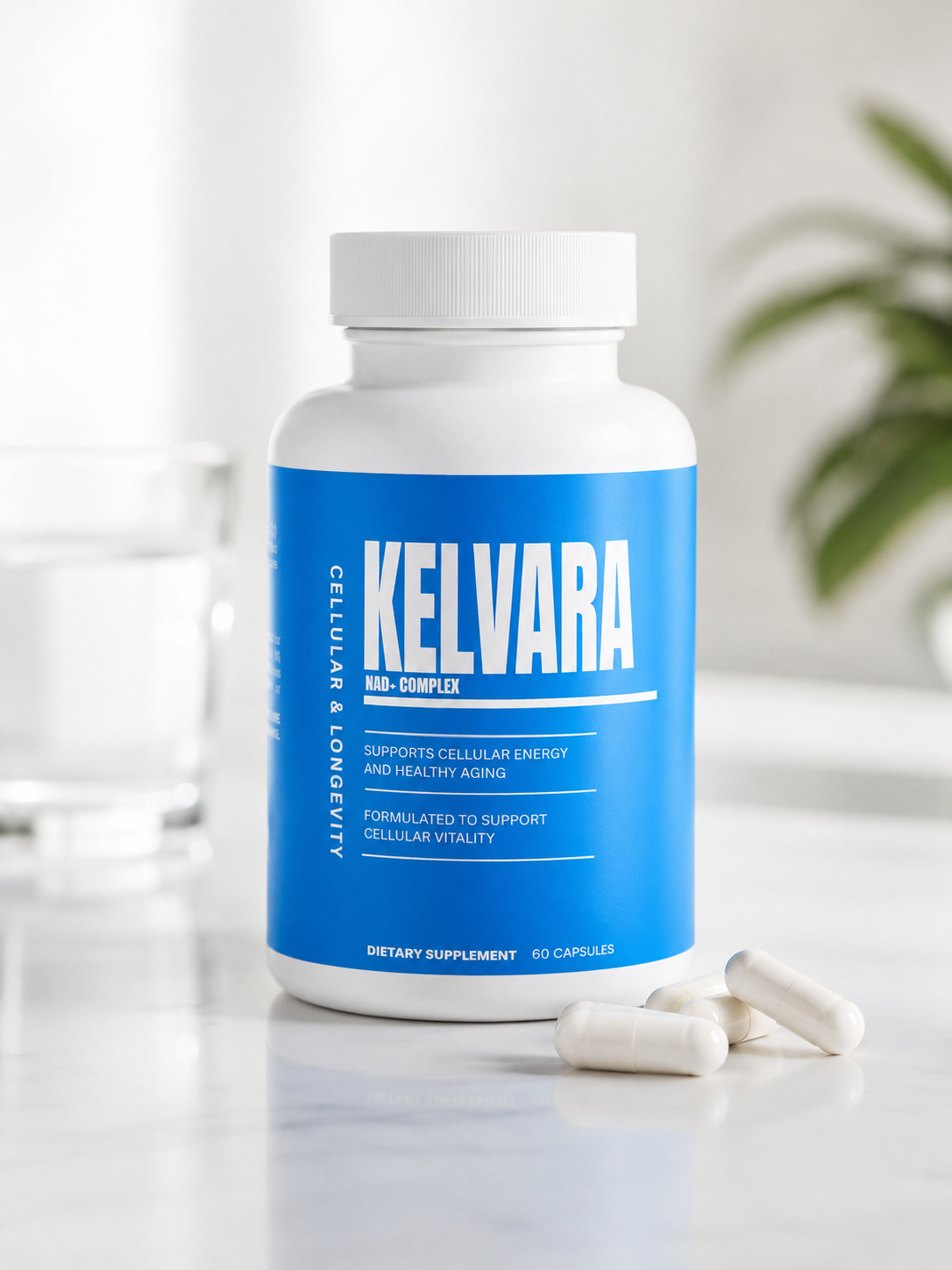
Rather than relying on a single precursor that depends on the compromised NAMPT pathway, Kelvara delivers a bioavailable NAD+ precursor specifically selected because its conversion does not require NAMPT to complete. It enters the cellular energy cycle directly — bypassing the degraded production pathway and delivering NAD+ where the mitochondria need it.
Kelvara's bioavailable precursor bypasses the compromised NAMPT salvage pathway, feeding directly into the mitochondrial energy cycle. This supports sirtuin activation — the DNA repair and metabolic regulation pathway linked to cellular resilience by Harvard's Dr. David Sinclair — and restores the mitochondrial output that drives focus, physical recovery, and sustained drive. Third-party tested. Clinically referenced. Formulated for bioavailability, not marketing claims.
What Changes When the Foundation Is Restored
The improvements that come with restored NAD+ levels don't arrive the way a stimulant does. What happens is a gradual recalibration — a baseline shift that becomes more apparent the longer it accumulates.
Days 3–7: The Subtle Shift
Most people notice the absence of something rather than a dramatic presence. The afternoon drag that had become standard starts to ease. The second cup of coffee that felt mandatory starts to feel optional. Pay close attention — it doesn't announce itself loudly.
Weeks 2–3: Cognitive Clarity Returns
The focus window lengthens. Deep work that required increasing effort to sustain starts to feel more natural — less managed, more effortless. The drift comes later in the session, if at all.
Weeks 3–4: Physical Recovery Compresses
Workouts that were taking two days to clear start clearing in one. Output that felt capped starts moving again. Not dramatically — but meaningfully, in the ways that matter to someone tracking their performance.
Month 2 Onward: Sustained Baseline
The compounding effect becomes clear. NAD+ restoration is infrastructure work. The results build over weeks and months the same way the depletion happened — gradually, then unmistakably.

"My thoughts are more organized. I seem to be more motivated as well. I got more done in the first week of this stuff than I had in the previous six months."
Verified Reviewer, 44"I always feel energized all day. Something that isn't supposed to be this easy after 40. My cardio is back to where it was two years ago — without the crashes I'd been dealing with."
Verified Reviewer, 52 — Runner"It's not a jolt. It's more like a heightened motivation to take on the day. The drive that I thought I'd just lost — it's back."
Verified Reviewer, 47The Real Cost of the Performance Gap
There's a version of this decision that comes down to a straightforward calculation.
If you are spending serious time and money on your training, your nutrition, your sleep, and your supplement stack — and all of it is operating on a cellular energy foundation that is 30, 40, or 50% below where it was a decade ago — then a meaningful percentage of that investment is not returning what it should.
Every hour of deep work at diminished cognitive output. Every workout that doesn't fully convert effort into adaptation. Every morning where getting started requires more activation energy than it used to. Multiplied across months and years, these represent a substantial gap between what you're putting in and what you're getting out.
The optimizer's question is not "Is this worth trying?" It's: "What has the status quo already cost me — and what does it continue to cost me for every month I don't address the foundation?"
30-Day Money-Back Guarantee
Try Kelvara for a full 30 days. If you don't notice a meaningful shift in your energy, focus, or recovery — you pay nothing. No runaround, no explanation required.
Third-Party Tested & Clinically Referenced
Kelvara's formulation references published clinical literature and is independently verified for purity, potency, and label accuracy. Not a proprietary blend. Not a marketing claim.
You've Built the System.
This Is the Foundation It's Been Sitting On.
Try Kelvara for 30 days. Third-party tested, clinically referenced, and backed by a full money-back guarantee.
Shop Kelvara — Free Shipping →† These statements have not been evaluated by the Food and Drug Administration. This product is not intended to diagnose, treat, cure, or prevent any disease. Individual results may vary. Results shown are not typical. Always consult a qualified healthcare professional before beginning any new supplement regimen.